PRESENTED is an
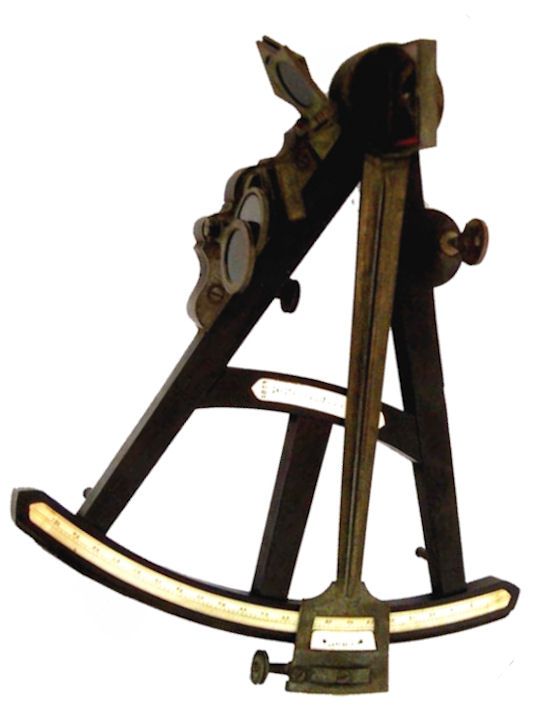
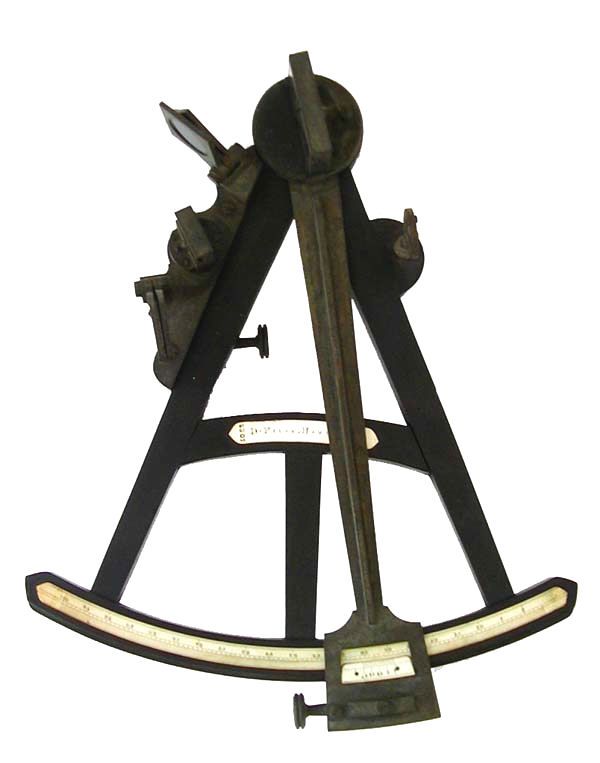
extraordinarily rare mid 19th C mariner’s sextant with ebony frame, ivory
graduated arc and vernier, and bronze fittings. This instrument is so rare that
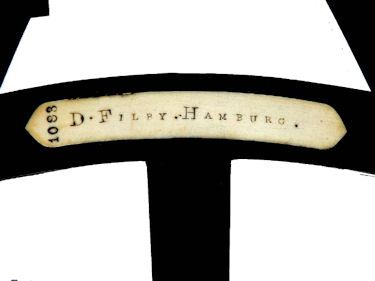
we have only seen pictures of one other. On the ivory name plate,
in the center of the gently curved
cross bar which is a
Filby trade mark, there is inscribed “D. Filby . Hamburg .” with the number
1083*.
This
beautifully made instrument has
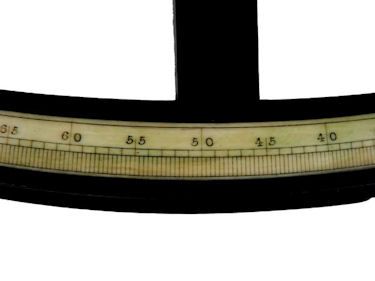
a ribbed brass index arm measuring 11 inches. The arc measures from – 5 to
plus 100 degrees. The top horizon mirror is on an adjustable turntable and can
be rotated by loosening a screw which locks the mirror’s position. Note the
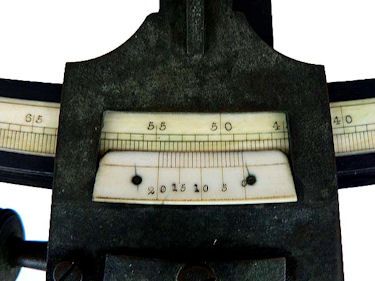
early form ivory vernier scale, reading from right to left from 0 to 20 arc
minutes, two hole peep sight with “flap”, and three sun shades for the index
mirror and two for the horizon mirror. We do not take the number 1083 * to be a
serial number or date because the instrument’s style makes it an octant and
because the business was only started in 1837. All of its features indicate the
instrument to be from the middle of the 19th century, likely Ca
1840.
 |
|
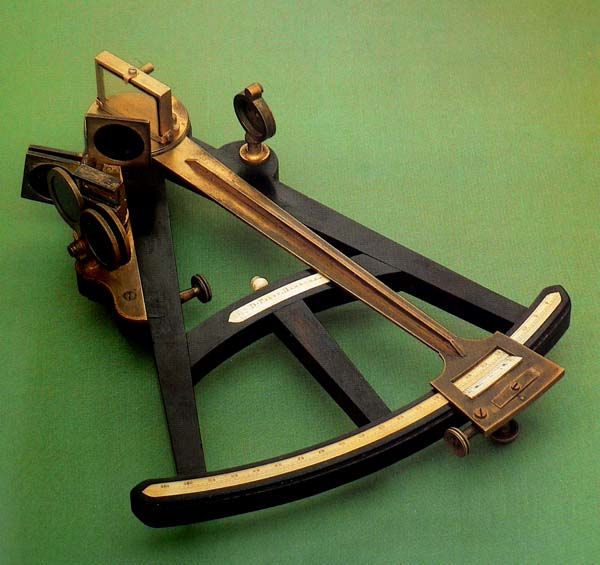
As shown in the
C. Plath book “From Sextant to Satellite Navigation,1837-1987″ |
Some
time after 1780, the addition of
a tangent screw as fitted here allowed for fine adjustment and represented one
of the two major changes in the basic operation of the octants and sextants for
the next 150 years! The second was the fitting of telescopes. As was the
practice with octants, only peep sights were fitted. Later a handle was added to
sextants. All of these tell tales indicate it is one of the earliest of that
type offered by David Filby making it a noteworthy instrument by this maker in
more than one respect.
Name Plate and Number 1083
Old Style Vernier
Scale
Precisely Engraved Ivory
ArcCONDITION: The instrument, its ivory name plate,
sharply and precisely engraved graduated arc, and its hardware are in museum
quality condition. There is a nice patina and verdigris of age. All three bronze
legs are present. A small piece is broken off the spring clip on the index lock
which doesn’t impair its use. Missing is one the small ivory scribe, and the
small ivory plate on the back. The horizon mirror is in remarkably good
condition and the index mirror has little silver remaining. The instrument has
that nicely worn look that comes with over 165 years of age. There is no
case.
All in all, an outstanding example from a historic
German instrument maker which gave rise to the C. Plath
sextant
DIMENSIONS:
3/4″
mm
shade glassesWeight 2
Lbs
mirrors and machinery
PROVENANCE: David Filby was born in 1810 in Husum,
Germany. His father was an innkeeper. In 1820 the family moved to Hamburg
which was a major seaport with vessels arriving and departing for Britain,
France, Portugal and Spain, and the United States of America as well as to the
Caribbean and South America.Nothing is known about Filby’s
youth. In 1830, at age 20
he began a four-year apprenticeship as a “mechanikus” in the workshop of
Heinrich Johann Kosbu, an instrument maker for Physics. Kosbu’s workshop was
adjacent to what was then the inner port in the centre of Old Hamburg, Those
who worked on the Kehrwieder came into daily contact with the ships, the
captains, the mates and the crews from countries all over the world. After
completing his apprenticeship, he continued to work for Kosbus until he set up
his own business in 1837 at age 27. To legally be in business his firm had to
be registered, and the owner had to be a citizen of Hamburg which was a separate
State. Filby did not achieve citizenship until 1840 having operated his company
illegally for the 3 preceding years. Years later, this beginning caught up with
Filby due to a clerical error in filing the notice of the sale to Plath. He was
brought before the commercial court and fined 15 marks, a cause of embarrassment
since he was by then a delegate to the city parliament.The Filby shop was on the
Vorsetzen directly on the so
called “Rummelhafen” where large numbers of sailing ships frequently blocked the
view over the Elbe. In his shop he stocked charts, nautical literature and
increasingly nautical instruments, which he first imported from Britain, the
country then known worldwide as producers of the best instruments.As was the practice, Filby had
the first instruments he
sold, marked with the name of his firm, D. Filby, Hamburg”. He soon set up a
repair workshop for nautical instruments, which grew in the course of the of
the next few years into an independent factory for the production of nautical
instruments comprised mainly of sextants. For the next 25 years the firm devoted
itself to serving the needs of seafarer’s by providing nautical instruments of
the highest quality, and their sextants were known through out the maritime
industry as some of the best.These efforts quickly brought him
success and public
recognition. For reasons not known, he sold his business to Carl Plath in
1862, when he was just 52 years old. When Plath acquired the Filby firm he chose
to name his new company, “C. Plath, D. Filby’s Successor”, indicating the high
esteem he had of Filby’s business and his intention to
maintain Filby’s tradition of importing, making and selling navigational
instruments.After the sale, Filby devoted himself
to numerous honorary
offices until his death.In 1882, three years after Filby’s
death, Carl Plath sold
the nautical literature and charts department of the business to the newly
established firm of Eckardt & Messtorff, a bookshop which is said to exist
today keeping the nautical instrument business as the foundation of his
own.The Filby Foundation for the relief
of poor and needy
seaman and seamen’s widows in Hamburg” and “The Filby Foundation Prize for the
Hamburg School of Navigation were established in 1894 and operated until
1923.C. Plath
ceased sextant production in 2002 after
137 years.