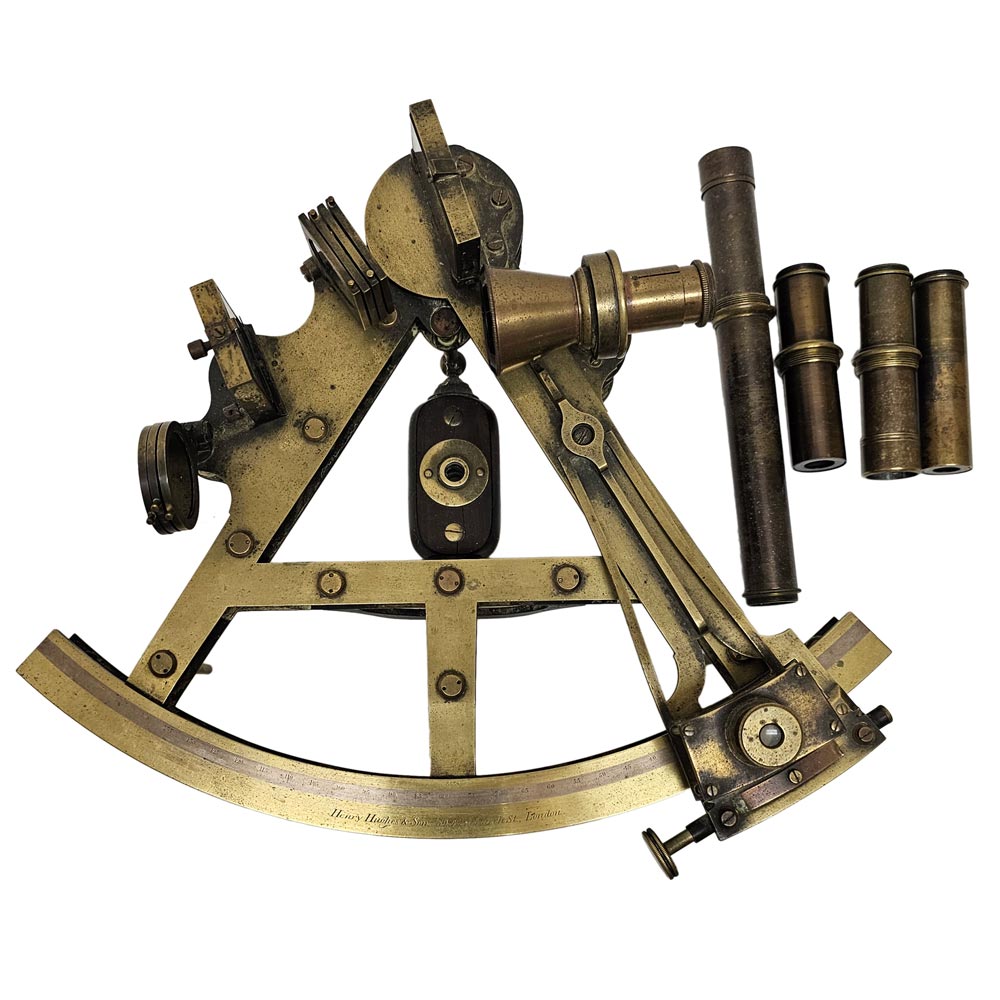
The sextant was the most important navigational instrument ever devised, the tool that made ocean crossings possible. Here’s what collectors need to know before buying one.
Why Sextants Matter
Before GPS, before radar, before any electronic device, there was the sextant. For three centuries, this single instrument enabled long-distance ocean navigation. A skilled navigator with a sextant, a chronometer, and a clear horizon could determine a ship’s position anywhere on Earth to within a mile.
That combination of mechanical precision, mathematical elegance, and world-changing practical importance makes the sextant one of the most compelling objects in the history of science and technology. It is also one of the most beautiful, a precision instrument crafted from brass, ebony, ivory, and glass by some of the finest instrument makers who ever lived.
What a Sextant Does
A sextant measures the angle between a celestial body, typically the sun at noon or specific stars, and the horizon. That angle, combined with the exact time from a chronometer and reference tables, yields a line of position. Two or more lines of position, from different celestial bodies or the same body at different times, give a fix, the ship’s position on the chart.
The instrument itself consists of a frame (the arc), a movable index arm with mirrors, a telescope, and a graduated scale. The navigator looks through the telescope, adjusts the index arm until the reflected image of the sun sits exactly on the horizon, and reads the angle from the scale. The required precision is extraordinary; an error of one arc-minute amounts to roughly one nautical mile.
What Collectors Look For
The maker’s name is paramount. Instruments by Spencer Browning, Cary of London, Troughton & Simms, Jesse Ramsden, Henry Hughes, and Norie of London are the most sought after. These firms represented the pinnacle of instrument making during the eighteenth and nineteenth centuries.
The frame type matters. Double-frame sextants — with two brass or bronze arcs braced together — are among the most valuable. Earlier instruments with ebony frames and ivory arcs have a beauty and rarity that metal-frame examples cannot match, though they are fragile, and condition becomes a critical factor.
Completeness adds significant value. A sextant in its original, fitted mahogany case, with spare mirrors, colored shades, adjustment tools, and the maker’s certificate, is worth considerably more than the instrument alone.
Era and Evolution
The earliest navigational instruments were cross-staffs and astrolabes, replaced by the octant (invented independently by John Hadley and Thomas Godfrey around 1731) and then the sextant, which extended the arc to 60 degrees and allowed measurement of larger angles.
Eighteenth-century sextants are the rarest and most valuable. These early instruments, often with ebony frames, represent the birth of precision celestial navigation. Nineteenth-century examples are more commonly available and include magnificent double-frame brass instruments from the great London and American makers. Early twentieth-century sextants, particularly those with military provenance from the World Wars, have their own collector following.
Condition and Authenticity
A collectible sextant should have all its mirrors, shades, and the telescope intact. The arc should be clearly graduated and legible. The index arm should move smoothly. Signs of honest age, patina on the brass, and wear marks consistent with use are expected and acceptable. Over-polishing that removes engraving detail or maker marks diminishes value.
Beware of instruments cobbled together from parts of different sextants. Check that the serial numbers on the frame, arc, and index arm are consistent. Replacement mirrors and shades are common and generally acceptable, but a replaced arc or index arm fundamentally changes the instrument.
The Investment Case
Fine antique sextants have appreciated steadily for decades. The supply is fixed, no one is making eighteenth-century Spencer Browning sextants anymore, and the demand from collectors, maritime museums, and decorative buyers continues to grow. A museum-quality sextant from a recognized maker, in excellent condition with provenance, is both a beautiful object and a sound investment.
Browse our Vintage Navigation Equipment →
Questions about a specific sextant or navigation instrument? Contact Land and Sea Collection at 772-287-7022.
Land and Sea Collection — trusted by collectors, museums, and military families since 2003. Palm City, Florida.