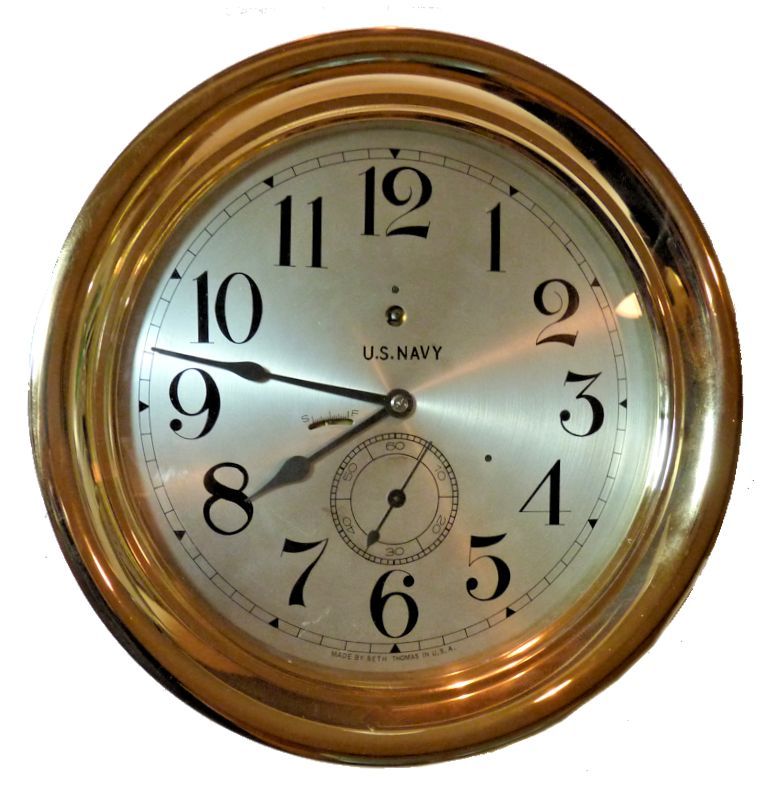
Walk into any serious collection of maritime antiques, and you will find two names on the clock faces more than any others: Chelsea and Seth Thomas. Both are American. Both supplied the U.S. Navy. Both produced instruments of remarkable quality. But they are not interchangeable, and understanding the differences is essential for anyone building a collection.
Chelsea: The Navy’s Clockmaker
Chelsea Clock Company of Boston earned its reputation on the water. Founded in 1897, the company quickly became the preferred supplier of ship clocks to the U.S. Navy, a relationship that endured through both world wars and beyond.
What sets Chelsea apart is the combination of movement quality and case construction. Their eight-day, jeweled movements are built to withstand the vibration and temperature swings of life at sea. The forged brass cases — not stamped or cast, but forged — resist corrosion and hold up to decades of salt-air exposure.
Among collectors, the 10-inch Pilot House clock is one of the most impressive maritime clocks ever produced. World War I and II era Navy clocks bearing the Naval Observatory cartouche are highly prized. And the 24-hour face combat room clocks, designed for continuous operations, are genuinely rare.
Seth Thomas: America’s Oldest Clockmaker at Sea
Seth Thomas began making clocks in 1813, decades before Chelsea existed. The company’s maritime line grew from its established reputation for reliable American clockwork, and by World War II, Seth Thomas was a primary supplier of Mark I deck clocks to the Navy.
The Seth Thomas Navy deck clock is visually distinctive; the Bakelite case gives it an immediately recognizable profile. These clocks carry the Naval Observatory cartouche and were built to military specifications for accuracy and durability.
Seth Thomas also produced larger ship’s bell clocks with exposed bottom bells, beautiful instruments that combine the visual appeal of the bell with the precision of the movement. Rare examples with 8-inch viewable faces command serious collector attention.
Which Should You Collect?
The choice between Chelsea and Seth Thomas often comes down to what draws you to maritime clocks in the first place. If you are drawn to the Navy’s operational heritage, clocks that served in combat rooms and pilot houses, Chelsea tends to dominate that space. If you appreciate the broader sweep of American horological history and the distinctive aesthetic of the Bakelite-era deck clocks, Seth Thomas offers exceptional value.
Both makers produced clocks that keep excellent time after proper service, and both carry historical significance that appreciates over the years. The best collections include examples of each.
There is also a third option pursued by serious collectors: Hamilton marine chronometers. The Model 21 and Model 22 are not clocks in the traditional sense but precision navigation instruments. A Hamilton chronometer in its original gimbaled case is a statement piece that bridges the worlds of timekeeping and celestial navigation.
Condition and Value
For both Chelsea and Seth Thomas, the movement is everything. A clock that runs accurately on its eight-day wind and strikes the correct bell sequence is the baseline. Surface wear on the case is secondary; brass can be polished, but a worn movement is expensive to restore.
Navy-issue clocks with verified cartouches and traceable serial numbers carry a premium. Complete sets, including a clock with a matching barometer, on original stands, are especially desirable.
The supply of authentic wartime maritime clocks is finite. Production ended decades ago, and each year the available inventory shrinks. Current prices reflect this reality, and the trajectory has been consistently upward for quality examples.
Browse our Maritime Clocks collection →
Contact us at 772-287-7022 to discuss specific items in our current inventory.
Land and Sea Collection — museum-quality nautical antiques since 2003. Palm City, Florida.