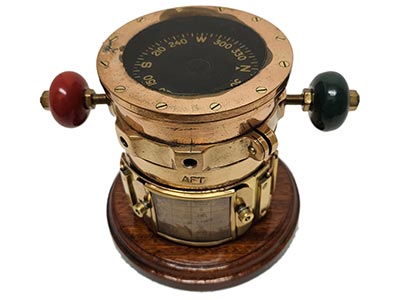
A binnacle is far more than a compass stand. It’s the navigational nerve center of every sailing vessel and warship, and one of the most sought-after categories in nautical antiques today.
The Binnacle Defined
A binnacle is the stand or housing that holds the ship’s compass on the bridge or deck. But that simple definition barely scratches the surface. The binnacle is where navigation happened, the place where officers and helmsmen gathered to read the compass, check the heading, and steer the ship across oceans.
The word comes from the Portuguese “bitácola” or the Spanish “bitácula,” both derived from the Latin “habitaculum,” meaning a small dwelling place. And that is exactly what a binnacle is — a dwelling for the compass, designed to protect it from weather, vibration, and the magnetic interference of the ship itself.
Why Binnacles Were So Complex
An iron or steel ship creates its own magnetic field, which pulls the compass away from true magnetic north. This is called deviation, and it has plagued navigators since iron hulls replaced wooden ones. The binnacle evolved from a simple wooden stand into an engineering solution for this problem.
By the Victorian era, binnacles carried compensating magnets, iron spheres (called Kelvin balls after Lord Kelvin, who perfected the system), and a Flinders bar, all designed to cancel out the ship’s magnetic influence on the compass. A properly adjusted binnacle was the difference between accurate navigation and a shipwreck.
This is why antique binnacles are so visually striking. Those brass spheres on either side are not decorative; they are quadrantal correctors, precision-placed iron masses that compensate for specific types of deviation. The craftsmanship required to build and calibrate these instruments was extraordinary.
Types of Binnacles Collectors Seek
The skylight or cathedral binnacle is perhaps the most recognizable and sought-after style. These tall, elegant housings feature glass panels on top that allow the compass card to be read from above, often lit by an internal lamp or candle. E.S. Ritchie of Boston, Kelvin & Wilfrid O. White, and Wilcox Crittenden all produced notable skylight binnacles that are prized by collectors today.
Standard pedestal binnacles — the classic brass column design seen on warships and merchant vessels — are equally collectible, particularly those from the Royal Navy or U.S. Navy with documented service histories.
Smaller boat binnacles, designed for yachts and lifeboats, offer an accessible entry point for new collectors. These compact units still display remarkable craftsmanship and often feature gimbaled compasses that remain perfectly level regardless of the ship’s motion.
Famous Binnacle and Compass Makers
The names that matter to serious collectors include E.S. Ritchie & Sons of Boston, one of the most respected American compass makers since the 1850s; Kelvin & James White (later Kelvin & Wilfrid O. White) of Glasgow, whose instruments were standard equipment on Royal Navy vessels; John Bliss & Son of New York, among the few American firms that manufactured chronometers from scratch; and Henry Browne & Son (Sestrel) of England, whose Sestrel compasses were fitted to vessels worldwide.
Negus of New York, Dent of London, and Henry Hughes & Son are also names that command attention when they appear on a compass card or binnacle plate.
What Makes an Antique Binnacle Valuable
Condition, maker, completeness, and provenance all play a role. A binnacle with its original compass, compensating equipment, and lamp housing intact is worth considerably more than one that has been stripped or modified. The brass should show honest age, polished but not over-restored.
Provenance adds another dimension. A binnacle from a named vessel, particularly one with a documented history, carries a story that elevates it beyond its material value. At Land and Sea Collection, we research the history of every piece and provide that context in our listings.
Binnacles as Statement Pieces
Beyond their appeal to collectors, antique binnacles have become some of the most dramatic decorative objects in interior design. A skylight binnacle standing three feet tall in polished brass commands any room. They work equally well in a coastal home, a corporate lobby, or a library, anywhere that appreciates craftsmanship, history, and the romance of the sea.
The Humphrey Bogart connection helps, too. A skylight binnacle identical to those seen aboard the yacht Santana in the 1948 film “Key Largo” has become an icon of nautical style.
Pairing Binnacles with Maritime Art
Collectors and designers who display a binnacle often discover it calls for a companion on the wall. A fine marine oil painting or a carved wooden eagle in the style of John Bellamy turns a single statement piece into a curated maritime gallery. Sailor-made woolwork embroidery, ship portraits by listed artists like Frederick Cozzens or James E. Buttersworth, and folk art whale carvings all pair naturally with the polished brass of a binnacle — creating the kind of layered, storied interior that no decorator showroom can replicate.
Land and Sea Collection carries a rotating selection of maritime fine art and folk art alongside our navigational instruments, because we know from experience that these pieces belong together.
Browse our Binnacles & Compasses collection →
Also explore our Maritime Fine & Folk Art → https://landandseacollection.com/id115.html
Questions about a specific binnacle or compass? Contact Land and Sea Collection at 772-287-7022.
Land and Sea Collection — trusted by collectors, museums, and military families since 2003. Palm City, Florida.